How to Audit a Graphic Overlay Supplier Before Sourcing
Sourcing graphic overlays based solely on unit price and sample appearance is how field failures happen. Before committing to a production order, experienced OEM buyers ask these operational questions to separate true manufacturers from trading companies.
Ask for a live video tour of the production floor. A direct factory will show you their print room, die shop, and lamination lines immediately. Trading companies will delay or offer stock photos.
Subcontracting creates accountability blind spots. When a batch fails incoming inspection, vertically integrated factories identify and fix the process within the same shift. Fragmented supply chains take days just to trace the root cause.
2. DFM, FAI, and Material Traceability
If a supplier says, “we will print directly from your file,” expect failures. Serious manufacturers run a strict Design for Manufacturability (DFM) review to check window clearances against press tolerances before cutting material.
Once production begins, they execute First-Article Inspection (FAI). Without FAI, a registration drift that starts at piece 30 of a 1,000-piece run goes undetected until it hits your receiving dock. For medical devices or UL-rated systems, material traceability is mandatory. ISO-compliant factories log incoming film and adhesive by lot number, ensuring you survive regulatory audits.
3. Color, Tolerances, and Emboss Consistency
Never accept “we match to the screen.” Factories must use D65 standardized lighting and physical Pantone standards. For back-printed overlays, color must be verified through the substrate under backlighting, as a 0.3mm polycarbonate layer shifts the visual color significantly.
Dimensionally, panels fitting into tight machined bezels require strict ±0.2mm tolerances. Ask about their die tool maintenance schedule to prevent dimensional drift. Finally, verify how they manage emboss consistency. Tool temperature gradients in multi-cavity presses can cause center keys to form deeper than corner keys, creating “dead keys” during tactile operation.
4. Advanced Material Application
“We use PC or PET” is an insufficient answer. A 0.25mm polycarbonate film rated for outdoor UV behaves completely differently than indoor-grade film. The adhesive required for a textured powder-coated housing is fundamentally different from what works on smooth ABS.
A factory that stocks 3M 467MP and 468MP—and can technically explain when to use each—makes decisions based on engineering. A supplier offering “whatever is in the warehouse” makes decisions based on inventory.
At BX-PANEL, we manufacture custom graphic overlays, membrane switches, and embossed panels entirely under one roof at our Xiamen facility. We execute DFM, FAI, and lot traceability on every single batch.
Company Backing: Your Trusted Manufacturing Partner
Bx-Panel has been at the forefront of the electronic printing and HMI industry for nearly 10 years. Located in Xiamen, Fujian, China, we operate a state-of-the-art 3,000㎡ manufacturing facility powered by over 100 skilled workers and a dedicated, innovative design team.
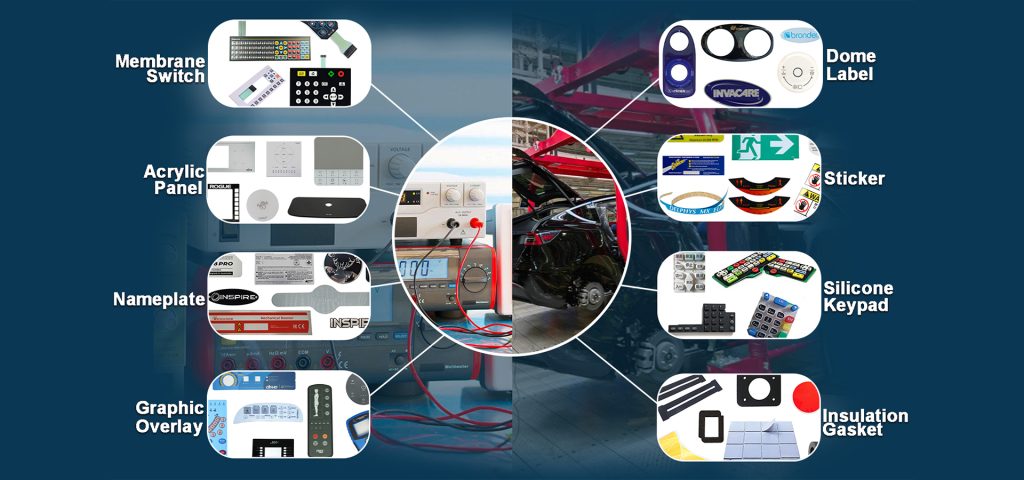
As a premier membrane switch manufacturer, our extensive business scope includes: