


In industrial automation projects, membrane switches are often installed directly on control cabinets, HMI panels, or equipment enclosures. On paper, everything looks correct — proper voltage rating, correct circuit layout, standard insulation design.
But once the system is powered on, strange problems start appearing.
Buttons trigger randomly.
LED indicators flicker.
Sometimes the panel resets without warning.
If the panel is located near a variable frequency drive (VFD) or inverter, electromagnetic interference (EMI) is usually the hidden cause.
This is not a rare situation. In industrial environments, EMI is everywhere — and membrane switches are more sensitive to it than many engineers expect.
Why EMI Affects Membrane Switches More Than You Think
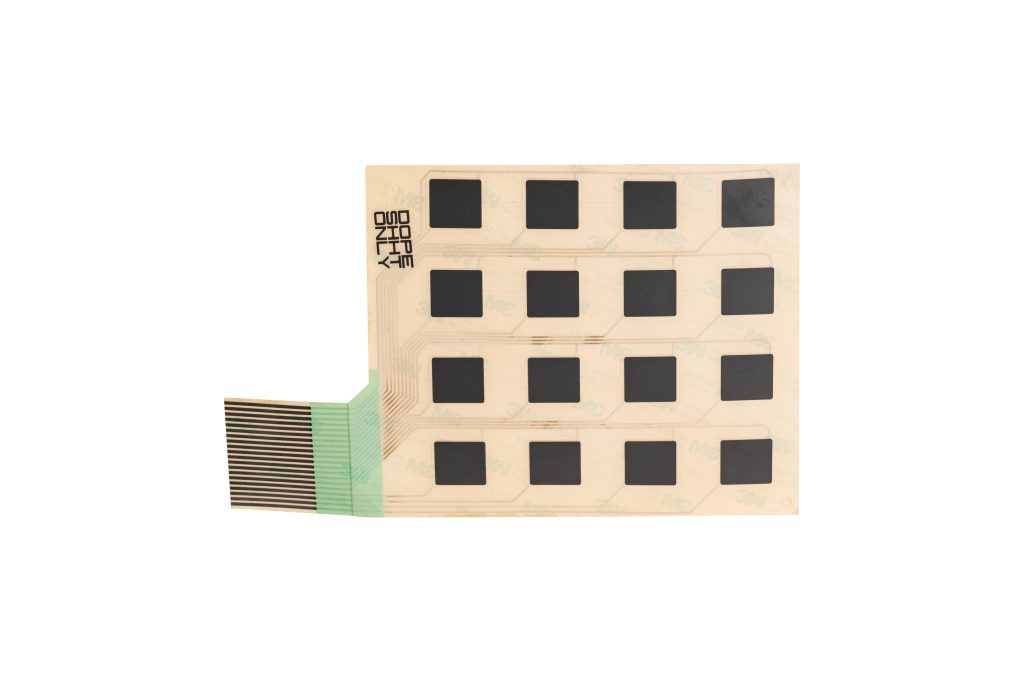
A membrane switch circuit typically uses thin silver traces printed on polyester. The structure is compact and cost-efficient, but it also means:
- The circuit layer has minimal shielding by default
- The signal traces are relatively close together
- The overall structure is lightweight and flexible
When installed near high-power devices such as inverters, servo drives, or switching power supplies, electromagnetic noise can couple into the switch circuit.
Once interference enters the signal lines, several issues may occur:
- False triggering
- Unstable signal transmission
- Controller misinterpretation of inputs
- Long-term degradation of circuit reliability
In industrial control systems, even minor instability is unacceptable.

Where the Risk Is Highest
From practical experience, problems most often appear when:
- The membrane switch is mounted on a metal cabinet without proper grounding
- There is no shielding layer integrated into the switch stack
- The tail connector runs parallel to high-current cables
- The inverter output cables are not properly separated
In these cases, the switch is not defective — it is simply unprotected in a noisy environment.
Practical EMI Protection Methods That Actually Work
Through real industrial projects, several design solutions have proven effective.
1. Add a Shielding Layer
A conductive shielding layer (such as carbon or silver ink) can be printed within the switch structure and connected to ground. This significantly reduces electromagnetic coupling.
For higher-level applications, adding a metal shielding layer bonded to ground can further improve performance.
2. Improve Grounding Strategy
Shielding only works if grounding is correct.
The shielding layer must have a reliable connection to system ground. Floating shielding provides little protection.
In many cases, adding a grounding point near the tail connector improves stability immediately.
3. Separate Signal and Power Routing
The switch tail should avoid running parallel to high-current or inverter output cables.
Even a small routing change inside the cabinet can dramatically reduce interference.
Cable layout is often overlooked, but in industrial environments, it makes a measurable difference.
4. Consider EMI Early in the Design Stage
The most cost-effective solution is to plan for EMI protection before production.
Retrofitting shielding after mass production increases cost and delays delivery.
If the application involves:
- Variable frequency drives
- High-power motors
- Switching power supplies
- Heavy industrial equipment
EMI protection should be treated as a baseline requirement, not an optional upgrade.
Durability and EMI: A Hidden Connection
There is another factor that is often overlooked.
Long-term exposure to electromagnetic interference does not only cause signal errors. It can also accelerate circuit aging.
Repeated electrical stress may gradually affect silver traces and contact reliability. Over time, this contributes to reduced lifespan.
This is why EMI protection is not only about signal stability — it is also about long-term durability.
We will explore this durability aspect in detail in the next article.
Final Thoughts
In industrial environments, membrane switch failures are not always caused by poor materials or manufacturing defects.
Often, the real issue is environmental interference.
A properly designed shielding structure, combined with correct grounding and cable management, can dramatically improve performance and reliability.
Industrial membrane switches are reliable — but only when they are designed for the environment they operate in.