



Buyers who run into graphic overlay problems after delivery usually share one thing in common: they evaluated suppliers on price and sample appearance and skipped the questions that reveal how a factory actually runs.
These are the questions experienced OEM buyers ask before committing to a production order. Some of them sound basic. The answers are not.

1. Do You Manufacture In-House, or Do You Subcontract?
Get a specific answer, not a general one. Ask which processes — printing, die-cutting, lamination, embossing, assembly — are done at your facility and which go to outside shops.
Suppliers who subcontract have no direct control over the processes they hand off. When a batch fails incoming inspection, tracing the root cause across three separate facilities takes days. Corrections take longer. A vertically integrated factory — everything under one roof — can identify and fix a process issue within the same shift.
If the answer to this question is vague or redirected, that tells you something before you’ve asked anything else.
2. What Substrate Materials Do You Stock, and Can I Specify the Grade?
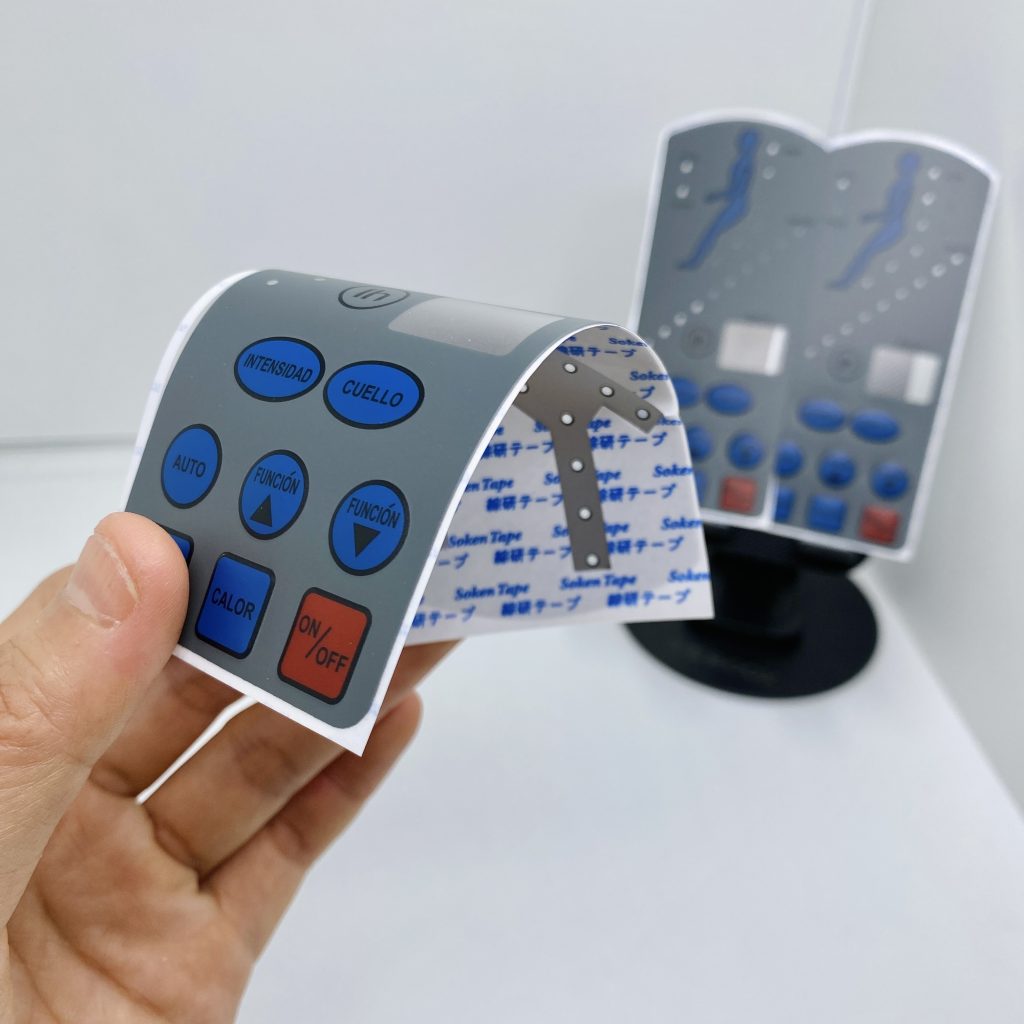
“We use PC or PET” is not a sufficient answer. Push for specifics: which film thickness ranges, which surface treatments, which UV resistance grades, and which adhesive part numbers are stocked in-house.
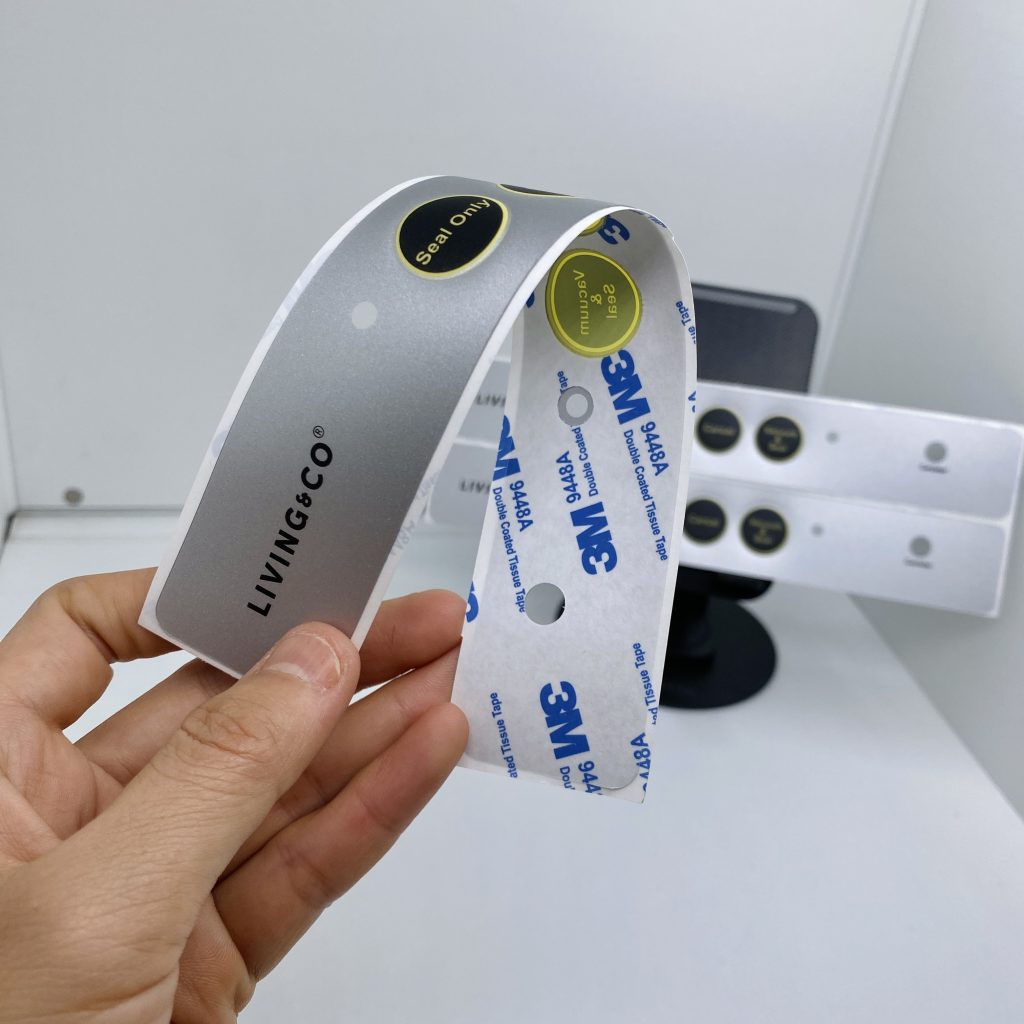
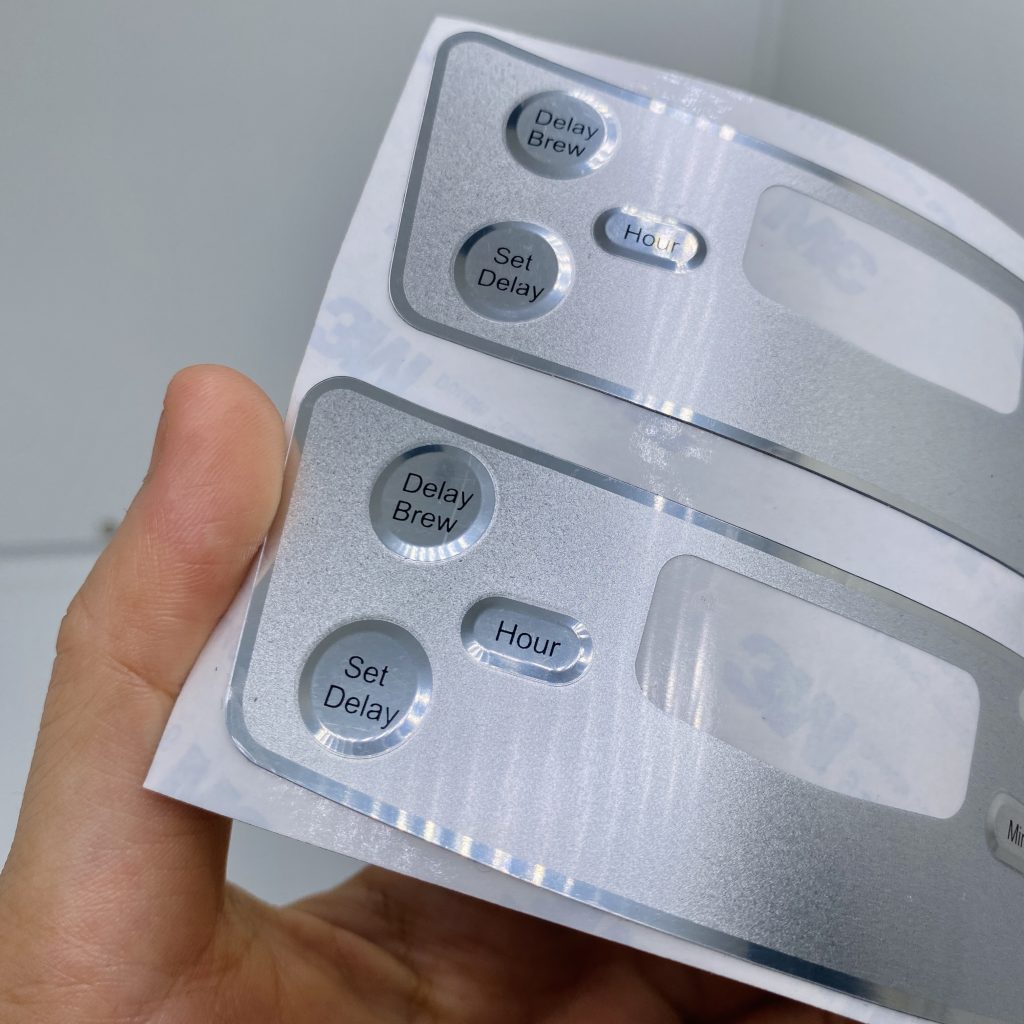
A 0.25mm polycarbonate film rated for outdoor UV exposure behaves differently in production than a standard indoor-grade film at the same nominal thickness. The adhesive tack required for a textured powder-coated housing is different from what works on smooth ABS. A factory that stocks 3M 467MP and 468MP and can explain when to use each understands material selection. One that offers whatever is available in the warehouse is making your material decision based on inventory, not application.
3. How Do You Control Color Accuracy Between Sample and Production?
Color drift is the most common dispute between overlay buyers and factories. Two root causes dominate: the sample was printed on different equipment than the production run, or color comparison was done on a monitor rather than against a physical Pantone standard under controlled lighting.
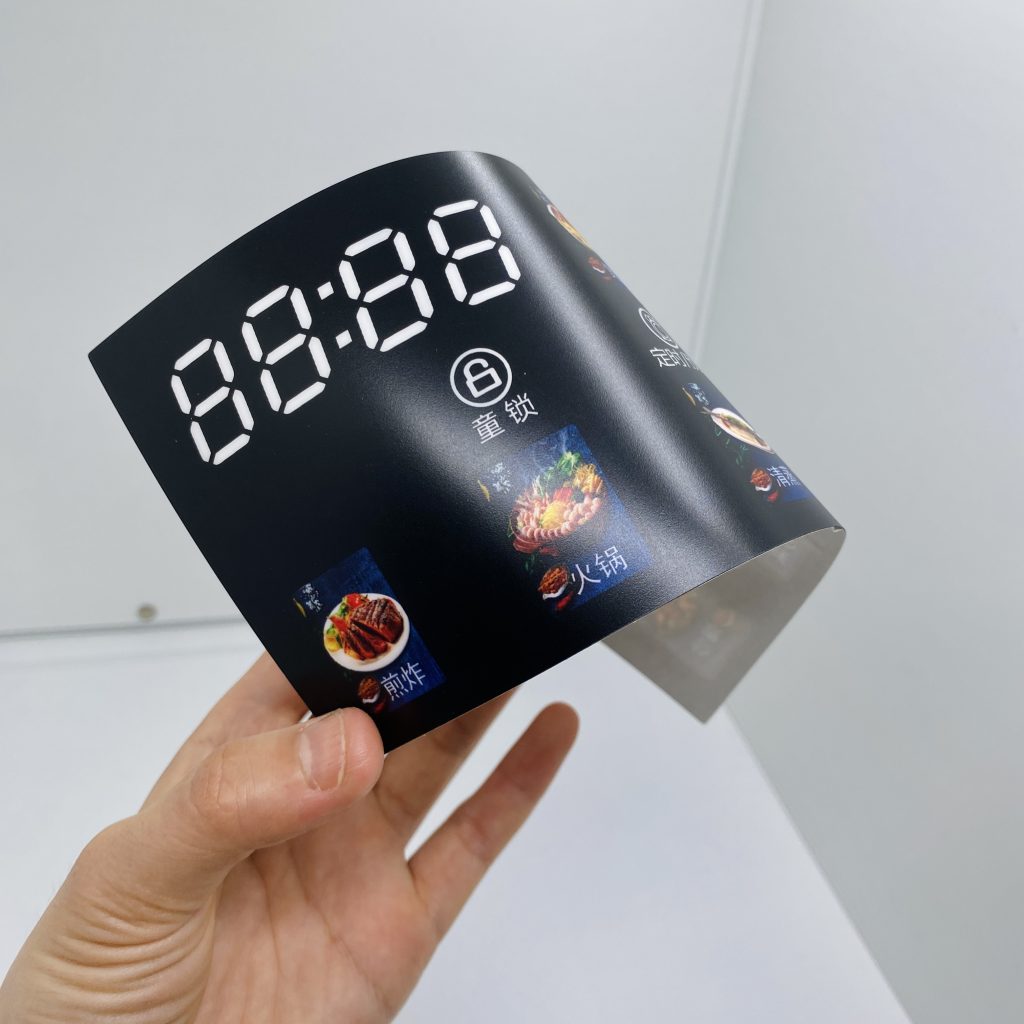
Ask whether they use D65 standardized lighting for color sign-off. Ask whether the same press and ink system are used for both sample and production. For back-printed overlays — where the color layer sits behind the PC film — ask whether color is verified through the substrate under backlighting, not just face-up on the press bed. A color that reads correctly on the surface can shift one to two Pantone steps when viewed through 0.3mm of polycarbonate under diffused LED illumination.
4. What Tolerances Do You Hold on Die-Cut Dimensions?
Standard industry tolerance for die-cut overlays runs ±0.3mm to ±0.5mm. For panels fitting into machined housings with tight bezel clearances — common in industrial control and medical equipment — ±0.2mm on critical dimensions is often required.
Ask what the factory holds as standard, and whether tighter tolerances are available on specific features. Also ask about die tool maintenance: how often tools are inspected, what triggers a regrind or replacement, and whether there are documented records. A worn die produces dimensions that drift gradually across a run. Without a maintenance schedule, neither you nor the factory will know it’s happening until parts fail assembly.
5. Do You Run a DFM Review Before Making the Sample?
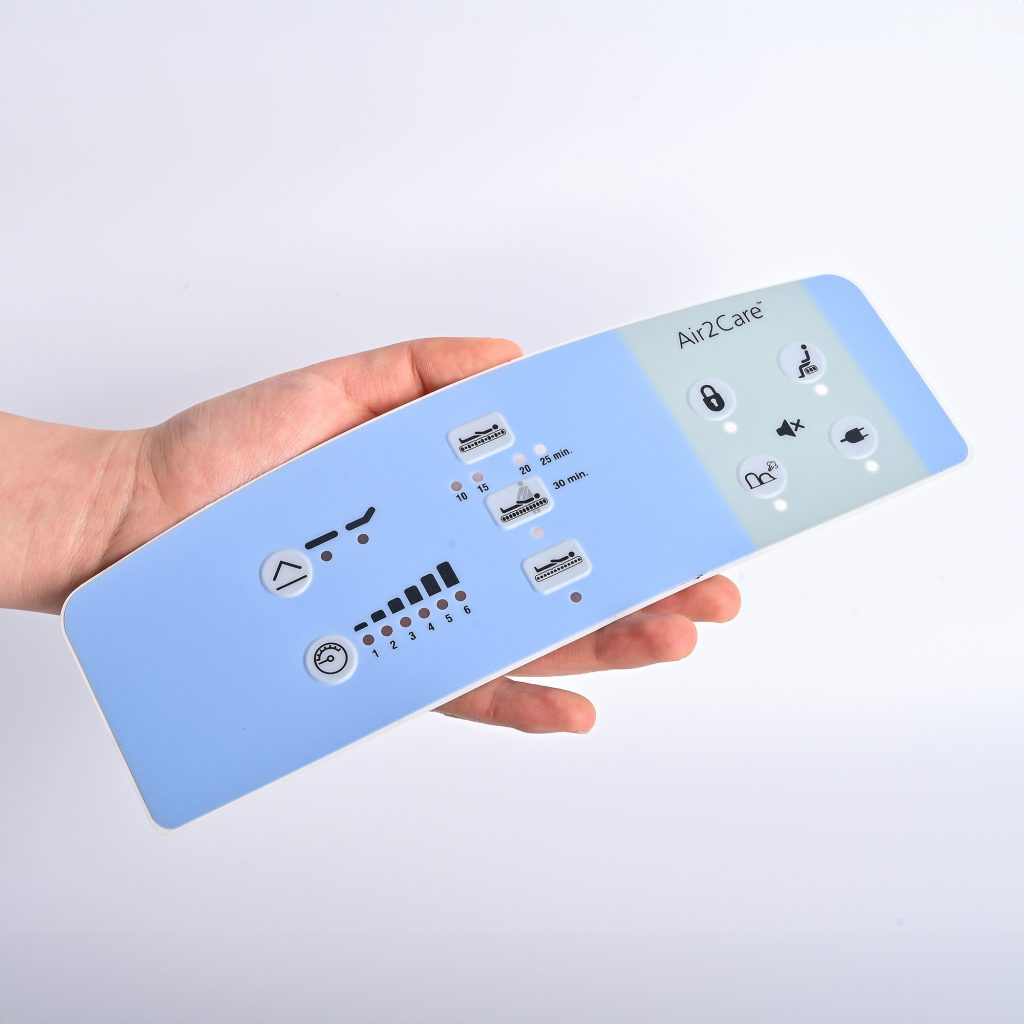
Design for Manufacturability review checks the customer’s artwork against actual production constraints before any material is cut. Window clearances against press registration tolerance, tolerance stack-up across multi-layer assemblies, adhesive step requirements at cutout edges, emboss geometry against tooling limits — these are the conditions that produce first-run failures when they go unchecked.
If a factory’s answer to this question is “we print from your file and send the sample,” that means the sample is built under manual, hand-corrected conditions that production volume won’t replicate. The sample passes. The production batch doesn’t.
Ask specifically what their DFM process covers. A factory that runs it as standard procedure will have a clear answer.
6. What Does Your First-Article Inspection Cover?
FAI is the verification checkpoint between the start of a production run and release of the full batch. A defined quantity of pieces from the first production output is pulled and measured against the approved drawing before the rest of the run continues.
Without FAI, a registration drift or dimension error that shows up in piece 30 of a 1,000-piece run goes undetected until your incoming inspection. Ask what FAI covers — dimensions, color, surface visual, adhesive coverage, emboss height — and whether the FAI record is documented and available to you. A factory that treats FAI as routine documentation will answer this without hesitation.
7. Can You Provide Material Traceability?
For overlays going into medical devices, industrial control systems, or any safety-rated application, traceability is not optional. If a field failure occurs, your customer or regulatory body will ask for the material lot number and production batch record behind the affected parts.
Ask whether incoming film and adhesive are logged by lot number and linked to specific production orders. Ask whether a material certificate is available for the film and adhesive in your batch. ISO-compliant factories maintain this as a standard record. Factories sourcing materials on a spot basis generally do not.
8. How Do You Manage Emboss Consistency Across a Full Run?
For overlays with raised embossed keys, consistency across the full production run is a process control problem, not just a tooling problem. Tool temperature gradients between edge and center cavities on a multi-cavity tool produce measurable variation in emboss height — center keys forming deeper than corner keys on the same press cycle. Material lot variation in forming temperature adds to this.
Ask whether emboss height is measured at multiple panel positions during press setup, and at defined intervals during the run. Ask how they compensate for edge-cavity temperature loss. A factory running embossing at volume without active monitoring produces panels that look consistent and feel inconsistent — something that only shows up when an operator runs the panel by hand or under raking light inspection.
9. Is Your Lead Time Based on Your Own Schedule or a Subcontractor’s?
A trading company quoting 15 business days is quoting their subcontractor’s current availability. When that subcontractor picks up a large order or hits a quality hold, your job moves without notice.
A direct factory quotes lead time against its own press schedule and material stock. Ask where the actual bottleneck sits — material procurement, print queue, finishing — and what lead time looks like during peak periods, not just this week. A factory that manages its own capacity can give you a specific, reliable answer. One that doesn’t can only quote what they’ve been told
10. Can I Visit or Audit Your Production Facility?
The purpose of this question is not necessarily to book a flight. It is to see how the supplier responds.
A factory with real in-house production — print room, die shop, embossing press, lamination line, inspection stations — can arrange a walkthrough or a live video tour on short notice because the equipment is there and running. They will confirm the address, name the departments, and offer access without hesitation.
A trading company presenting as a manufacturer will redirect, delay, or offer factory photographs instead. How a supplier handles this question is one of the fastest filters available before you commit to a production order.
A Note on Using These Questions
None of these are trick questions. They are process questions with clear answers — answers that any factory running its own production will have on hand. The value of asking them is not in catching suppliers out. It is in finding out, before your order is placed, whether the factory you are talking to actually controls the process you are buying.
In our experience at BX-PANEL, buyers who work through questions like these before ordering rarely encounter first-run quality issues. The conversation itself does the filtering.
Xiamen XINBIXI Electronic Technology (BX-PANEL) has operated its own production facility in Xiamen for over 10 years. Pre-press engineering, screen printing, UV digital printing, embossing, lamination, die-cutting, and final assembly all run under one roof, with hundreds of workers across dedicated departments. DFM review runs on every new part. FAI runs on every production order. Material traceability is maintained on every batch.
Ask us any of the above. We will give you specific answers.
Contact BX-PANEL
Xiamen XINBIXI Electronic Technology Co., Ltd. (brand: BX-PANEL) manufactures custom graphic overlays, membrane switches, and integrated control panel assemblies for industrial, medical, and commercial equipment.
- Email: [email protected]
- Website: www.bx-panel.com
- Capabilities: Custom graphic overlay manufacturing, membrane switch production, embossed panel assembly, DFM review, die-cut prototyping