QR Code Survivability on Metal Nameplates: Laser Engraving vs. Deep Etching
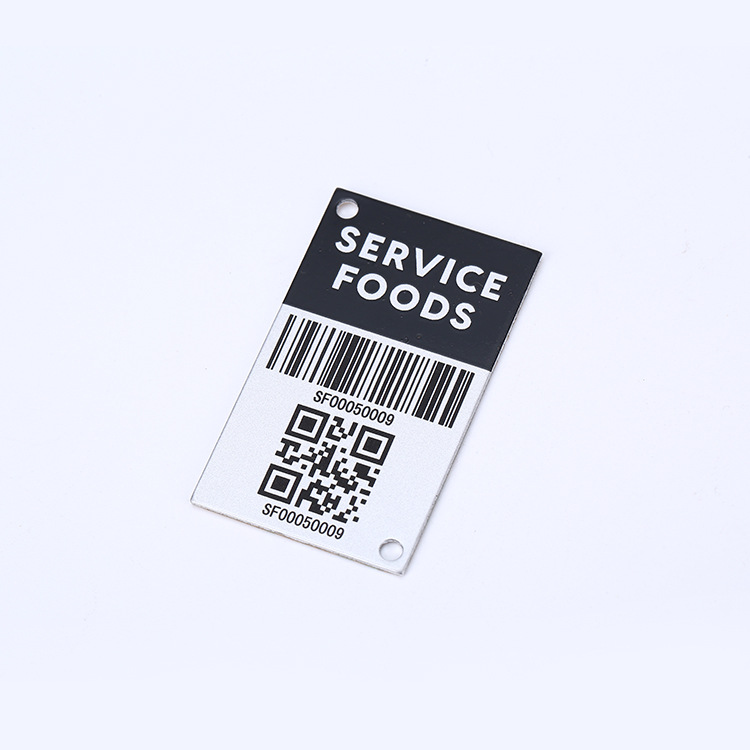
Equipment traceability fails when optical scanners cannot read degraded QR codes. In harsh industrial environments, grease, solvents, and mechanical abrasion destroy surface-level contrast.
To guarantee a 10-year readable lifespan for variable data (QR codes, barcodes, serial numbers), engineers must specify the correct marking process based on physical wear, not just cost.
Here is the technical breakdown of Laser Engraving vs. Chemical Etching.
1. The Failure Mechanism: Loss of Optical Contrast
Barcode scanners do not read color. They read the contrast ratio between the dark mark and the light metal substrate.
Contamination: Oil and dirt create a low-contrast film over the code.
Abrasion: Aggressive cleaning (wire brushes, abrasive pads) removes the dark marking material. Once the contrast ratio drops below the scanner’s threshold, the QR code is permanently dead.
2. Laser Engraving (Surface Marking)
Laser marking utilizes a concentrated beam to alter the metal surface. On stainless steel, this is typically thermal annealing (changing the metal’s color without removing material). On anodized aluminum, it ablates (vaporizes) the dyed anodic layer.
Manufacturing Advantage: Zero tooling cost per variable. Ideal for Variable Data Printing (VDP) like sequential serial numbers and unique, high-density QR codes.
Physical Vulnerability: The mark depth is minimal (often under 0.01mm).
Field Performance: Highly resistant to basic chemicals, but fails under heavy mechanical abrasion. If a maintenance worker aggressively scrapes a laser-annealed stainless steel plate to remove dried concrete or heavy rust, the oxidized QR code layer will be physically stripped away.
3. Deep Etching with Color Fill (Sub-Surface Marking)
Chemical etching uses a photo-resist mask and acid to physically dissolve the target metal substrate. Standard industrial depth is specified at 0.05mm to 0.12mm (0.002″ – 0.005″). The resulting cavity is then filled with baked epoxy or enamel ink.
Physical Advantage (Indestructible Contrast): The QR code ink sits safely below the surface plane of the metal.
Field Performance: You can grind the surface of the nameplate with an abrasive wheel. The physical impact hits the bare metal substrate, while the epoxy ink inside the recessed cavity remains untouched. Scanners will always read the contrast.
Manufacturing Limitation: Etching requires a physical photo-tooling mask. Creating a unique mask for every single variable QR code is extremely slow and cost-prohibitive.
4. Specification Guidelines for Engineers
Match the process to the operational environment:
Clean/Moderate Environment + Variable Data:
Spec: Laser Engraving.
Material: Anodized Aluminum (provides the highest optical contrast for laser marking).
Extreme Abrasive Environment + Static Data (Model specs, warnings):
The Hybrid Solution (Extreme Environment + Variable QR):
Spec: Deep etch the static templates. Leave a blank block. Use a high-power MOPA fiber laser to perform deep engraving (vaporizing material, not just annealing) for the unique QR code inside the block.
Final Thoughts
These tiny terminals and plastic housings account for a fraction of the membrane switch’s cost, yet they hold the absolute lifeline of your equipment’s signal transmission.
When prototyping and customizing with Bx-Panel, if you aren’t sure which connector to use, simply tell us two things: Is your machine prone to vibration? and How much space is left on the motherboard? Our team will directly match you with the most fail-safe terminal and housing solution.
Company Backing: Your Trusted Manufacturing Partner
Bx-Panel has been at the forefront of the electronic printing and HMI industry for nearly 10 years. Located in Xiamen, Fujian, China, we operate a state-of-the-art 3,000㎡ manufacturing facility powered by over 100 skilled workers and a dedicated, innovative design team.
As a premier membrane switch manufacturer, our extensive business scope includes: